

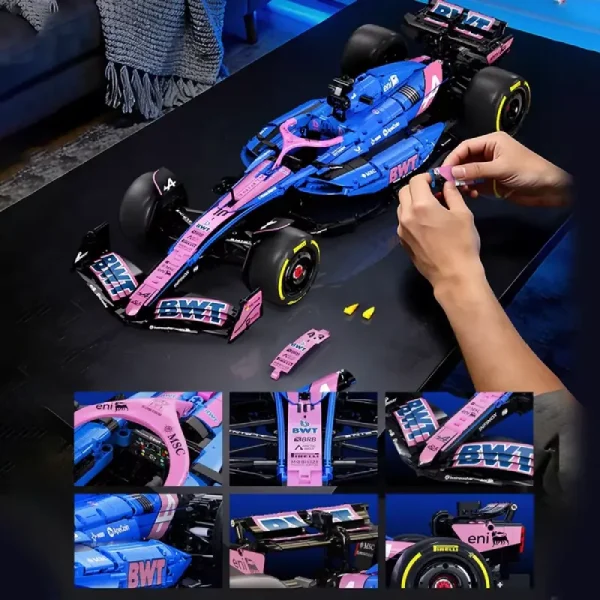
The CaDA C64012W Alpine A525 may be one of the best 1:8-scale Formula 1 building-block cars I have built so far.
Its packaging feels appropriately premium, while the quality and fit of the parts no longer need to be described as merely “close to LEGO.” More importantly, CaDA has not simply copied the familiar Technic building formula. It uses many of its own connection methods to recreate the suspension, floor and aerodynamic surfaces of a modern F1 car.
That does not mean it beats LEGO in every area.
The Alpine is more complicated to build, and some of that difficulty comes from genuinely rewarding mechanical design. Some of it, however, comes from instruction angles that are not always clear enough and building stages that contain too many bags. The completed body is impressively strong, yet the front wing does not feel as secure as the rest of the model.
Rather than asking whether the Alpine defeats LEGO outright, it makes more sense to understand what kind of building experience it offers and whether that experience suits you.

From the Moment You Open the Box, It Feels Like More Than a Bag of Parts
The first thing that impressed me about the CaDA Alpine was the packaging.
After removing the outer sleeve, I found two separate inner boxes covered with visuals connected to the Alpine F1 car. The thick instruction manual follows the same presentation style. From the moment the box is opened, the product tries to create the atmosphere expected from a large collector model.
The LEGO Ferrari F1 car I built previously did not give me the same experience. Once that outer box was opened, the main contents were the numbered bags and the instruction manual. CaDA treats the unboxing itself as part of the overall product.
Of course, not every builder cares about packaging. Some people would rather pay less and receive simpler boxes without the additional graphics or presentation.
For me, however, a 1:8-scale model of this size is not an ordinary toy that is assembled over a few evenings and then forgotten in a corner. The packaging, the manual and the finished display model should feel like parts of the same experience.
CaDA understands that clearly.

The Parts Now Feel Like They Belong to CaDA’s Own Standard
Once I started building, I quickly noticed that I was no longer constantly comparing every part with LEGO.
CaDA uses some different connection methods, but the clutch, the way beams and panels fit together, and the overall feel of the completed assemblies are all highly refined.
I no longer felt as though I was building an alternative product that was trying to imitate LEGO. This felt more like a technical building system with its own design language.
The lack of highly visible blue connector pins also improves the finished appearance. Exposed pins can interrupt the colour scheme of a large racing car, especially on a model with such a clear combination of blue, pink and black.
CaDA’s darker connectors blend into the chassis and bodywork much more naturally, giving the finished model a cleaner appearance.
According to CaDA’s official specifications, the C64012W contains 2,173 pieces and is built at 1:8 scale. The finished model measures approximately 71 cm long, 23 cm wide and 14 cm high. It includes a differential, push-rod suspension, mechanical steering and a moving V6 engine connected to the wheels. The engine cover, front wing and sidepod sections can also be removed to reveal internal Venturi tunnels and cooling structures. The body graphics are printed rather than applied with stickers.
Excellent parts, however, do not automatically create an equally polished building process.
The Alpine’s biggest problem is not the quality of the pieces. It is how those pieces are divided between stages and how the instructions communicate the most complicated connections.
The Real Challenge Comes From the Suspension, Not Just the Piece Count
The difficulty of this set is not created simply by adding more pieces.
What genuinely slowed me down was the front and rear suspension.
To reproduce the structure of a real F1 car, the rear suspension uses numerous links and tightly packed mounting points. The design itself deserves praise because the suspension has not been reduced to a few decorative arms whose only purpose is to hold the wheels in place.
The problem is that the instructions sometimes show the assembly from only one angle.
When a mounting point sits behind another beam or pin, it can be difficult to determine which hole should be used. It is not always immediately clear whether a suspension arm should face towards the front or rear of the car.
Once I completed the first side, the second side was much easier because I already understood the final geometry. During the first attempt, however, several steps required trial fitting and a certain amount of guesswork.
The front suspension suffers from the same issue.
This level of complexity could have been one of the most rewarding parts of the entire model, but the instructions do not always keep pace with the design. Additional front views, side views or enlarged diagrams would preserve the challenge while reducing unnecessary rebuilding caused by missing visual information.
The steering system is one of the strongest parts of the chassis.
It works entirely through mechanical connections and feels smooth in operation, without obvious binding or the uneven resistance that can appear in more complicated drivetrains.
CaDA Is Most Interesting When It Refuses to Follow Familiar Building Rules
Once I began adding the floor and bodywork, I understood why some builders find CaDA models difficult.
Many technical building-block products follow a logic similar to LEGO even when they come from different brands. Experienced builders can often predict how a panel or beam will be attached before they reach the relevant step.
CaDA frequently breaks those expectations.
When I expected a structure to be attached from above, the instructions sometimes required it to be secured from inside the chassis. When a body angle appeared to need a continuous row of panels, CaDA might instead combine axles, short beams and unusual connectors to create the shape in a completely different way.
That increases the time needed to understand the model, but it also keeps the build feeling fresh.
The floor edges and aerodynamic surfaces along both sides of the Alpine use numerous angled assemblies. Many display-oriented building-block cars sacrifice strength in order to achieve complicated shapes. They look good on a shelf, but moving them can cause panels to loosen or fall away.
The Alpine did not behave like that.
At one point, I discovered that I had missed an important part around 30 pages earlier. I had to dismantle a large section of bodywork that was already complete. During that process I repeatedly turned, lifted and pulled the chassis, yet the completed panels did not fall apart and the frame did not visibly distort.
That accidental rebuild demonstrated the structural quality more clearly than the normal assembly process could have done.
CaDA has not only created complex angles. It has made those angles part of a genuinely strong structure.
The Hidden Parts Make the Building Process More Meaningful
The Alpine also contains internal details that are almost invisible once the model is finished.
The sidepod areas carrying the BWT branding could easily have been built as hollow shells. From a normal display angle, there is very little opportunity to see what is underneath them.
CaDA still includes radiator structures inside the sidepods.
These parts do not make the finished model larger, nor do they add a new interactive function. Before the outer panels are installed, however, I can see that the bodywork is not hiding an empty space. I can also understand how these areas relate to the internal packaging of the real car.
Builders who care only about the finished appearance may not place much value on these hidden details.
For me, a large technical model should offer more than a final silhouette. The building process should gradually reveal how the car is put together.
The Bag Organisation Repeatedly Interrupts the Build
If I could choose only one area for CaDA to improve, it would be the bag organisation.
Some early stages require four numbered bags plus two unnumbered bags at the same time. In the final part of the build, stage seven uses four bags and stage eight uses five.
That leaves a large number of similar black beams, pins and axles spread across the work surface.
In many cases, more time is spent searching through several piles for one short axle or connector than understanding the next instruction step.
I am not the only builder to notice this problem.
“I actually prefer the CaDA build quality, but its bag organisation drives me mad. I do not remember having the same problem with LEGO Technic.”
— Paraphrased from Reddit user u/BeyondOk3697
Another builder described the difference between the two brands in similarly direct terms:
“LEGO offers a noticeably easier building experience and clearer instructions. CaDA stages are longer and harder to follow, and sometimes there are enough leftover pieces to make you wonder whether something has gone wrong. The finished models, however, are usually impressive.”
— Paraphrased from Reddit user u/LamBroghini750
Those comments closely match my own experience.
CaDA does not need to reduce the mechanical complexity. It only needs to divide each large stage into smaller and clearer sections so that the design can be enjoyed without constant parts searching.
The Front Wing Is One of the Few Areas That Does Not Inspire Confidence
Most of the completed car feels very strong, but the front wing does not reach the same standard.
Several of the separate wing elements are not held by direct and secure connections. Some rely on surrounding parts pressing down on them to remain in the correct position.
That method works reasonably well on one side, but not quite as well on the other. The front wing is not about to fall off immediately, yet it does not feel as secure as the floor, sidepods or main chassis when I move the model.
If this weakness appeared throughout the car, I would question the overall design quality.
Because the rest of the Alpine is so solid, however, the front-wing solution stands out more clearly.
It is not a serious enough flaw to undermine the whole set, but it is an area CaDA should address in its next generation of F1 models.
I Have Not Built the Latest LEGO MCL39, So I Cannot Present Assumptions as a Hands-On Comparison
It is almost impossible to discuss the CaDA Alpine without mentioning LEGO.
I should make one point clear before comparing them: I have not personally built the latest LEGO McLaren MCL39 42228. The following section is therefore not a direct hands-on comparison of both models. It combines my experience with the Alpine with LEGO’s official specifications, independent reviews and comments from builders who own both products.
According to LEGO, the MCL39 is also built at 1:8 scale and contains 1,675 pieces. The completed model measures approximately 61 cm long, 25 cm wide and 13 cm high. It includes push-rod and pull-rod suspension, steering, a differential, a two-speed gearbox, a V6 engine and an adjustable DRS rear wing. The instructions are also available through the LEGO Builder app with 3D viewing tools.
On paper, the CaDA model contains more pieces and is significantly longer. LEGO adds a two-speed gearbox and offers a more developed digital instruction system.
This is not simply a contest over which model has more functions. Each brand has placed its emphasis in a different area.
Jay’s Brick Blog reported that the MCL39 uses ten clearly numbered groups of paper bags, while the instruction manual and sticker sheet are protected in a separate cardboard folder. The review described the build as a fairly standard LEGO Technic F1 experience with a clear process, but criticised the large stickers, the gaps beneath the sidepods and the use of equally wide front and rear tyres. The site disclosed that LEGO supplied the review sample.
That creates a clear contrast with my experience of the Alpine.
LEGO is better at organising complicated mechanical systems into a smooth and predictable process. CaDA is more willing to use dense and unfamiliar connections in exchange for more challenging shaping and construction.
What Do Builders Who Own Both the CaDA Alpine and LEGO MCL39 Say?
Reddit user u/SnooBananas3484 said that they had completed the LEGO MCL39 immediately before building the CaDA Alpine. That makes the comment particularly relevant because the two models are the same ones discussed here.
“I had just completed the LEGO McLaren MCL39 and was very happy with it until this CaDA model arrived. I hope CaDA secures more team licences because it provides the level of quality and building experience these F1 cars deserve.”
— Paraphrased from Reddit user u/SnooBananas3484
The same builder also described the Alpine as challenging, praised the printed parts and reported no missing pieces. They felt that the floor and chassis construction was closer to the way a real F1 car develops around the monocoque than CaDA’s earlier Sauber model.
User u/ganzhimself focused on the printed decoration:
“This makes the LEGO F1 cars look weak by comparison. Printed parts and no stickers? I would look for one simply for the building experience.”
— Paraphrased from Reddit user u/ganzhimself
Not every opinion is entirely positive.
“Recent CaDA quality is almost on the same level as LEGO, although minor moulding issues still appear occasionally. Some structures feel closer to fan-designed MOCs and can become fragile when complicated shaping is prioritised, but the printed parts are excellent.”
— Paraphrased from Reddit user u/kwadratto
These comments are more useful than a simple claim that CaDA has already surpassed LEGO.
They suggest that modern CaDA sets should no longer be dismissed as low-cost imitations, but they also show that the brand has not achieved the same consistency in every part of the experience.
CaDA and LEGO Represent Two Different Product Priorities
| Comparison | CaDA Alpine A525 C64012W | LEGO McLaren MCL39 42228 |
|---|---|---|
| Scale | 1:8 | 1:8 |
| Piece count | 2,173 | 1,675 |
| Finished size | Approx. 71 × 23 × 14 cm | Approx. 61 × 25 × 13 cm |
| Mechanical features | Differential, push-rod suspension, steering, moving V6 engine and DRS | Push-rod and pull-rod suspension, steering, differential, two-speed gearbox, V6 engine and DRS |
| Body decoration | Primarily printed elements | Printed elements and large stickers |
| Stage organisation | A single stage may require four to six bags | Ten clearly numbered bag groups |
| Instructions | Some complicated areas lack additional viewing angles | Paper instructions and LEGO Builder 3D instructions |
After building the Alpine and reviewing the available information about the MCL39, I believe the biggest difference is not which model has more functions. It is how each company presents those functions to the builder.
LEGO’s strength is process.
The numbered bags are clear, the instructions are mature and complicated structures are usually divided into small, understandable steps. A build may still require hundreds of pages, but the builder rarely needs to stop and guess what the designer intended.
CaDA’s strength is structural density and novelty.
It is willing to use less familiar pieces and connection methods, and it adds mechanical detail even in areas that disappear beneath the bodywork. The trade-off is a build that can become more tiring, with instructions and bag organisation that have not yet fully caught up with the design itself.
If I want a relaxed, familiar build that progresses at a steady pace, LEGO may be the better choice.
If I want a model that forces me to stop, think and earn a stronger sense of achievement at the end, I am more likely to choose CaDA.
Is the CaDA C64012W Alpine A525 Worth Buying?
It is not the right set for every builder.
If this is your first large technical building-block model, the complicated suspension, broad building stages and occasional lack of supporting instruction angles may make the experience unnecessarily difficult.
If you have already completed several large racing cars and want your next model to offer more than a new colour scheme and body shell, the Alpine is highly appealing.
The parts feel mature, the structure is strong, the steering is smooth and the internal details are rewarding. The printed decoration also avoids the alignment problems and long-term ageing associated with large sticker sheets.
The model itself needs fewer improvements than the process around it.
If CaDA divides future stages into smaller bag groups, adds more viewing angles for complicated assemblies and strengthens the front-wing connections, its 1:8 F1 range will become much more complete.
Final Verdict
The CaDA C64012W Alpine A525 is not a perfect model, but it is one that left me genuinely satisfied when it was finished.
It does not carry me from the first bag to the final step with the clear and stable rhythm associated with many LEGO Technic sets. It makes me stop and check connection directions, search several bags for one short axle and occasionally dismantle a completed assembly because the instruction angle was not clear enough.
When the chassis, suspension, sidepods, floor and complex body surfaces finally come together, however, I can see what that extra time has produced.
If I had to spend my own money on it, I would still buy it.
It may not beat the LEGO MCL39 in every category, but for builders who enjoy complex mechanisms, printed bodywork, hidden detail and unconventional construction methods, it may be the more interesting choice.
What the Alpine really proves is not that CaDA has completely defeated LEGO. It proves that the market for large technical building-block cars now has more than one mature answer.
What the Alpine really proves is not that CaDA has completely defeated LEGO. It proves that the market for large technical building-block cars now has more than one mature answer.
Frequently Asked Questions
Is the CaDA C64012W Alpine suitable as a first technical building-block model?
Probably not. The front and rear suspension are complicated, some instruction steps lack supporting viewing angles, and a single stage may require several bags at once. It is better suited to builders who already have some experience with large technical models.
Is the part quality of the CaDA Alpine as good as LEGO?
Based on my build and recent builder feedback, CaDA’s clutch, fit and finished appearance are now very close to LEGO. Minor moulding differences or fragile local structures may still appear in some sets, so it would be misleading to say the two brands are identical in every case.
Which model is more difficult, the CaDA Alpine or LEGO McLaren MCL39?
The CaDA Alpine is more likely to feel difficult. It contains more pieces, uses less familiar connection methods, has complicated suspension and groups many similar black parts into large stages. The LEGO MCL39 also has a long build, but its instructions and bag organisation are clearer.
What is the biggest problem with the CaDA Alpine?
The biggest problem is the building process. Too many bags are opened within a single stage, increasing the time spent searching for parts. Some suspension steps need additional viewing angles, and the finished front-wing connections are not as secure as the rest of the car.
Is the CaDA Alpine a better purchase than the LEGO MCL39?
That depends on what you value. The LEGO MCL39 is the stronger choice for clear instructions, smoother stage organisation and a two-speed gearbox. The CaDA Alpine is more appealing if you prioritise printed decoration, complicated structures, hidden details and a more demanding building experience.